

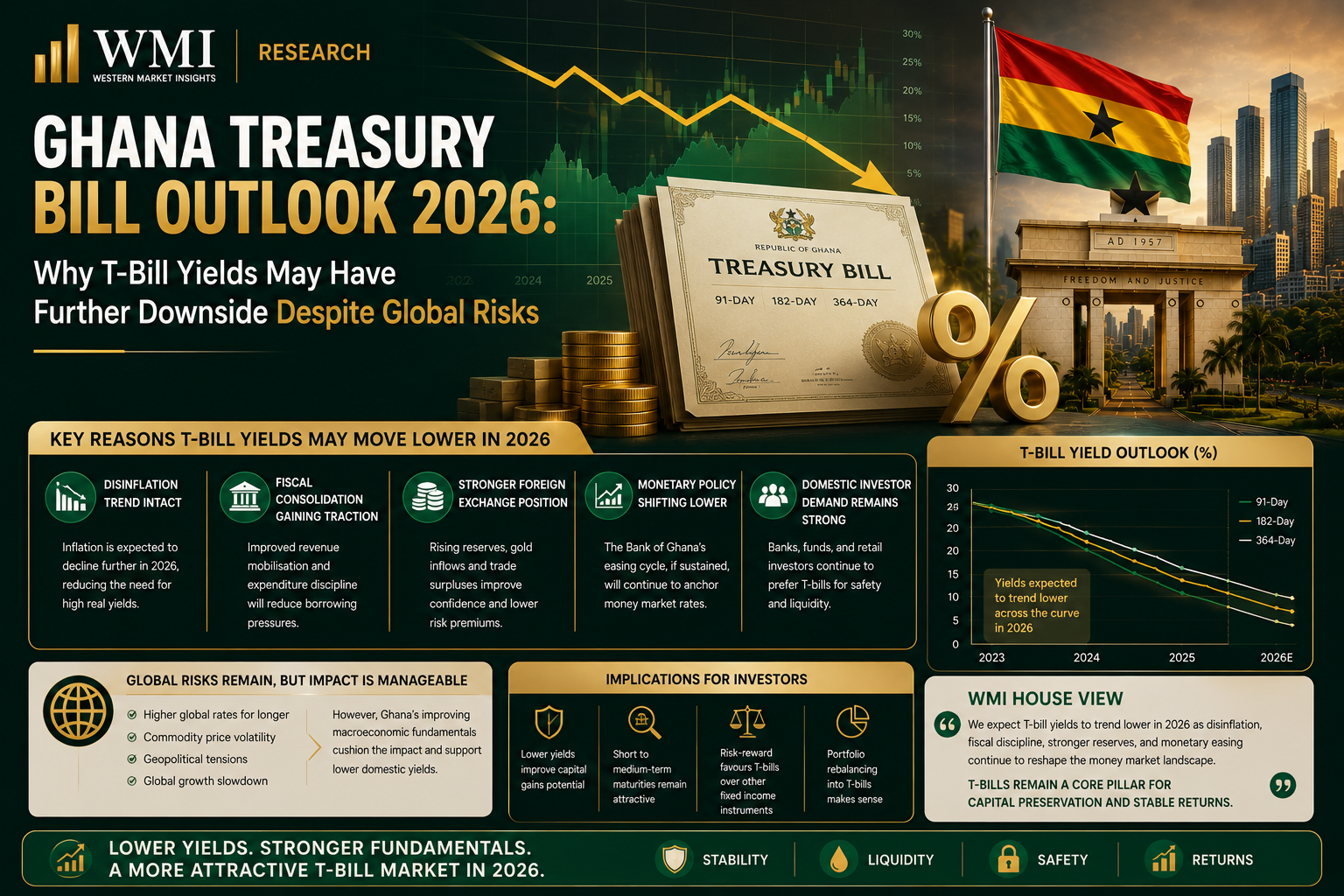
Why T-Bill Yields May Have Further Downside Despite Global Risks
WMI Fixed Income Intelligence Report
Ghana Treasury Bill Outlook 2026: Why T-Bill Yields May Have Further Downside Despite Global Risks
May 2026
Executive Summary
The Bank of Ghana’s May 2026 Monetary Policy Committee (MPC) decision has provided a critical signal for investors, fund managers, banks, pension funds, and treasury managers. While the MPC maintained the Monetary Policy Rate at 14.0%, the underlying message was clear: The Bank of Ghana remains comfortable with the current low-interest-rate environment and sees inflation risks as manageable. This suggests that Treasury bill yields are likely to remain low over the near term, although global geopolitical risks could slow the pace of further declines. For investors accustomed to double-digit T-bill returns, the era of easy fixed-income income generation appears to be ending.
What the MPC Is Really Saying
The headline decision was unchanged policy rates. However, markets should focus on three important messages:
- Inflation Remains Under Control
Headline inflation remains at only 3.4 percent despite rising geopolitical tensions. Core inflation continues to decline. This means the Bank of Ghana does not currently need higher interest rates to fight inflation.
WMI Interpretation
As long as inflation remains below the target band, there is little justification for significantly higher Treasury bill yields.
- Economic Growth Is Accelerating
The Composite Index of Economic Activity expanded by 12.6%. Private sector credit is growing strongly. Business activity continues to recover.
WMI Interpretation
The Bank of Ghana is shifting its focus from stabilization toward supporting growth.
That environment generally favors lower yields.
- Liquidity Conditions Remain Supportive
The MPC highlighted: Reserve money growth slowing, Strong banking sector liquidity
Rising deposits and Expanding credit. Meanwhile, banks continue to seek risk-free assets.
WMI Interpretation
Demand for Treasury securities remains stronger than supply. This structural demand will continue to suppress yields.
The T-Bill Market Today
Current Benchmark Yields:
| Instrument | Yield |
| 91-Day Bill | 4.90% |
| 182-Day Bill | 5-6% |
| 364-Day Bill | 7-8% |
The dramatic collapse from 2024 and early 2025 levels reflects: Falling inflation, Improved fiscal credibility, IMF program success, Strong reserve accumulation and Improved investor confidence
WMI Yield Forecast
Scenario 1: Base Case (70% Probability)
Most Likely Outcome
Assumptions:
- Oil remains below US$100
- Inflation stays below 6%
- Cedi remains stable
- Fiscal discipline continues
Expected Yield Range
| Instrument | Forecast |
| 91-Day | 4.0% – 5.5% |
| 182-Day | 5.0% – 6.5% |
| 364-Day | 6.5% – 8.0% |
WMI View
Yields remain broadly stable with a downward bias.
Scenario 2: Bull Case (20% Probability)
Stronger Recovery
Assumptions:
- Gold prices remain elevated
- Inflation remains below 4%
- Cedi strengthens further
- IMF program exceeds expectations
Expected Yield Range
| Instrument | Forecast |
| 91-Day | 3.5% – 4.5% |
| 182-Day | 4.5% – 5.5% |
| 364-Day | 5.5% – 7.0% |
WMI View
Treasury bill yields could reach the lowest levels seen in more than a decade.
Scenario 3: Bear Case (10% Probability)
Geopolitical Shock
Assumptions:
- Middle East conflict intensifies
- Oil exceeds US$100 per barrel
- Global inflation returns
- Dollar strengthens significantly
Expected Yield Range
| Instrument | Forecast |
| 91-Day | 6.0% – 8.0% |
| 182-Day | 7.0% – 9.0% |
| 364-Day | 8.0% – 11.0% |
WMI View
This is the principal downside risk identified by the MPC. However, current data suggest this remains a secondary scenario.
What Investors Should Do
If You Are a Money Market Investor
The golden era of high T-bill yields is over. Future returns will likely be lower than historical averages.
If You Are A Pension Fund/Mutual Fund
Extend duration gradually. Longer-dated government securities may offer better value than short-term bills.
If You Are a Bank
Lower yields will likely support credit expansion and profitability through increased lending.
If You Are an Equity Investor
Declining yields remain highly supportive for stocks. As Treasury bills become less attractive, capital may continue migrating toward equities.
The Hidden Signal Nobody Is Talking About
The MPC introduced a uniform 20% Cash Reserve Ratio requirement effective June 2026. This measure could absorb some liquidity from the banking system. However, the MPC simultaneously maintained the policy rate at 14%. This suggests that liquidity management—not monetary tightening—is the objective.
WMI Interpretation
The Bank of Ghana wants to maintain low inflation while preventing excess liquidity from destabilizing the foreign exchange market. This is not a signal of higher rates.
WMI Fixed Income Strategist View
The direction of Treasury bill yields remains downward to stable.
The fundamental drivers of lower yields remain intact:
- Inflation below target
- Strong reserve accumulation
- Fiscal discipline
- IMF program credibility
- Stable banking sector
- Improving growth outlook
The biggest threat to this outlook is not domestic policy. It is geopolitics. Unless global oil prices remain above US$100 for a prolonged period, Ghana’s Treasury bill market is likely to remain in a low-yield environment through the remainder of 2026.
WMI Forecast
91-Day Treasury Bill: 4.0%–5.5%
182-Day Treasury Bill: 5.0%–6.5%
364-Day Treasury Bill: 6.5%–8.0%
Investment Theme: Lower for Longer
The Bank of Ghana has effectively signaled that Ghana’s fixed-income market is transitioning from a crisis-era yield environment to a growth-era yield environment.