

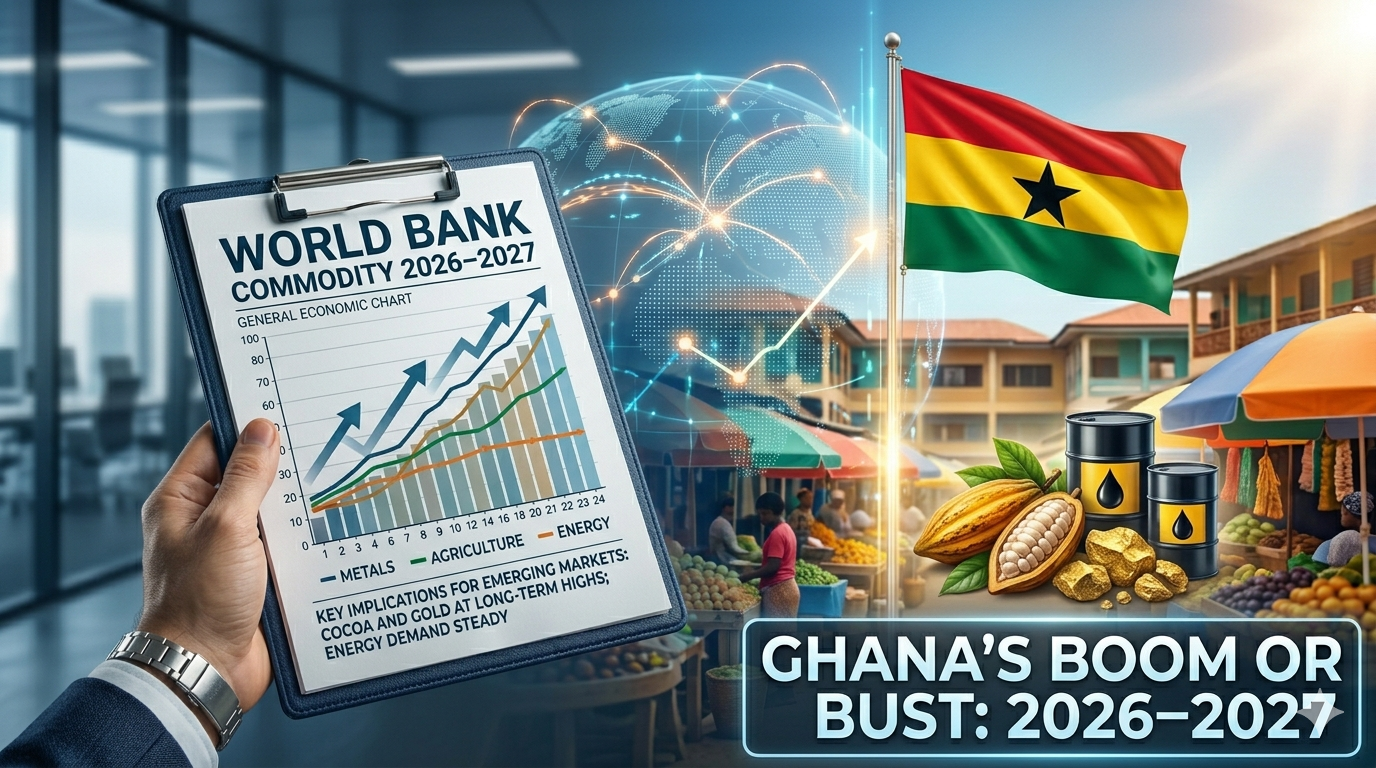
World Bank Commodity Outlook 2026–2027: What It Means for Ghana
WALLSTREET MARVEL INTELLIGENCE
COMMODITY STRATEGY REPORT
World Bank Commodity Outlook 2026–2027: What It Means for Ghana
Date: June 2026

Executive Summary
The latest World Bank Commodity Markets Outlook signals a major shift in the global commodity cycle. While energy, fertilizer, industrial metals, and gold prices are expected to remain elevated in 2026, several agricultural commodities—including cocoa—are projected to normalize sharply from their historic highs. For Ghana, the implications are profound. The country’s economic outlook in 2026 will increasingly be determined by a battle between:
Positive Forces
- Record gold prices
- Strong mining revenues
- Improved reserve accumulation
- Stronger investor confidence
Negative Forces
- Lower cocoa prices
- Elevated crude oil prices
- Expensive fertilizer imports
- Persistent food inflation risks
WMI believes Ghana is entering a period where gold replaces cocoa as the dominant external stabilizer of the economy.
Key Forecasts
| Commodity | 2025 | 2026 Forecast | Change |
| Gold | US$3,442/oz | US$4,700/oz | 36.60% |
| Brent Crude Oil | US$69/bbl | US$86/bbl | 24.60% |
| Cocoa | US$7.80/kg | US$3.80/kg | -51.30% |
| Copper | US$9,947/mt | US$12,000/mt | 20.60% |
| Palm Oil | US$1,007/mt | US$1,089/mt | 8.10% |
| Urea Fertilizer | US$423/mt | US$675/mt | 59.70% |
The End of the Cocoa Windfall
The most significant development for Ghana is cocoa. The World Bank expects cocoa prices to fall by more than 50% in 2026, from US$7.80/kg to US$3.80/kg. This does not imply a collapse of the cocoa industry. Rather, it reflects expectations that the supply disruptions which drove prices to record highs in 2024 and 2025 will gradually ease. However, for Ghana, the implications are substantial:
-
COCOBOD Revenue Pressure
Lower prices reduce export receipts and foreign exchange earnings.
-
Rural Income Slowdown
Farmers who benefited from exceptionally high global prices may face lower income growth.
-
Fiscal Risks
Government expectations for cocoa-related revenues may need adjustment.
-
External Sector Impact
The current account may become more dependent on gold exports.
WMI View:
The era of relying on extraordinary cocoa prices to support macroeconomic stability is ending.
Gold Becomes Ghana’s New Anchor
The World Bank expects gold to average approximately US$4,700 per ounce in 2026, representing another 36.6% increase. This is extraordinarily positive for Ghana.
Why Gold Matters
Gold is Ghana’s largest export commodity. At these price levels:
- Mining royalties increase
- Corporate tax receipts improve
- Export earnings strengthen
- Foreign reserves accumulate faster
- The cedi receives additional support
The Bank of Ghana’s domestic gold purchasing program could become one of the most important macroeconomic policy successes of recent years.
WMI View:
Gold is now Ghana’s strongest macroeconomic hedge against global uncertainty.
Oil Remains Ghana’s Biggest External Threat
Brent crude is forecast to average US$86 per barrel in 2026.
Although below previous crisis peaks, this still represents a significant increase from 2025.
For Ghana:
-
Higher Import Bill
More dollars will be required to purchase fuel.
-
Inflation Risk
Fuel costs feed directly into transportation and food prices.
-
Fiscal Pressure
Government may face pressure to intervene if fuel prices rise excessively.
-
Exchange Rate Risk
Higher oil imports increase demand for foreign currency.
WMI View:
Every US$10 increase in crude oil prices creates more pressure on the cedi than most investors realize.
Fertilizer Shock Could Create Food Inflation
Perhaps the most overlooked forecast is fertilizer.
The World Bank expects Urea prices to surge nearly 60% in 2026.
This matters because fertilizer costs eventually become food costs.
Potential impacts include:
- Higher maize production costs
- Higher rice production costs
- Increased poultry feed costs
- Upward pressure on food inflation
For policymakers attempting to maintain disinflation, fertilizer inflation may become a hidden challenge.
Copper’s Rally Signals Global Industrial Recovery
Copper is forecast to rise above US$12,000 per metric ton.
Historically, copper is considered one of the world’s most reliable indicators of industrial activity.
The rally suggests:
- Strong infrastructure spending
- Continued energy-transition investment
- Robust demand for electrification
- Ongoing AI and data-center expansion
Although Ghana is not a major copper producer, stronger global industrial activity typically supports emerging-market growth and investment flows.
Implications for Investors
Fixed Income
Positive:
- Gold supports macro stability.
- IMF program remains credible.
Negative:
- Oil and food inflation risks could slow rate cuts.
Equities
Potential beneficiaries:
- Mining companies
- Mining service providers
- Banks exposed to mining sector liquidity
Potential laggards:
- Consumer goods companies
- Manufacturers reliant on imported inputs
- Transport-intensive businesses
Foreign Exchange
The cedi outlook will increasingly depend on whether:
Gold inflows > Oil outflows
If gold earnings continue to outperform rising fuel import costs, Ghana’s currency stability could improve significantly.
What Policymakers Should Watch
- Gold reserve accumulation.
- Cocoa export earnings.
- Fuel import bill.
- Fertilizer inflation.
- Food price transmission.
- Current account performance.
- IMF program targets.
WMI Investment Conclusion
The World Bank’s latest commodity outlook suggests Ghana is transitioning into a new commodity regime. For nearly a century, cocoa has been Ghana’s flagship export. In 2026, however, the country’s macroeconomic fortunes will increasingly be determined by gold. Record gold prices provide a powerful opportunity to strengthen reserves, stabilize the cedi, and accelerate fiscal consolidation.
Yet rising oil prices and sharply lower cocoa prices mean policymakers cannot afford complacency.
WMI House View: Gold is Ghana’s shield. Oil is Ghana’s vulnerability. Cocoa is normalizing. The winners in 2026 will be investors and businesses positioned for a mining-led rather than cocoa-led growth story.